Garage Door Opener Repair in Rockville, MD
When an opener clicks, hums, flashes, reverses or ignores the remote, the cause may be electrical, mechanical or both.
Request a callback at any hour, describe what it is doing, and a technician checks the opener and the door together before any repair.
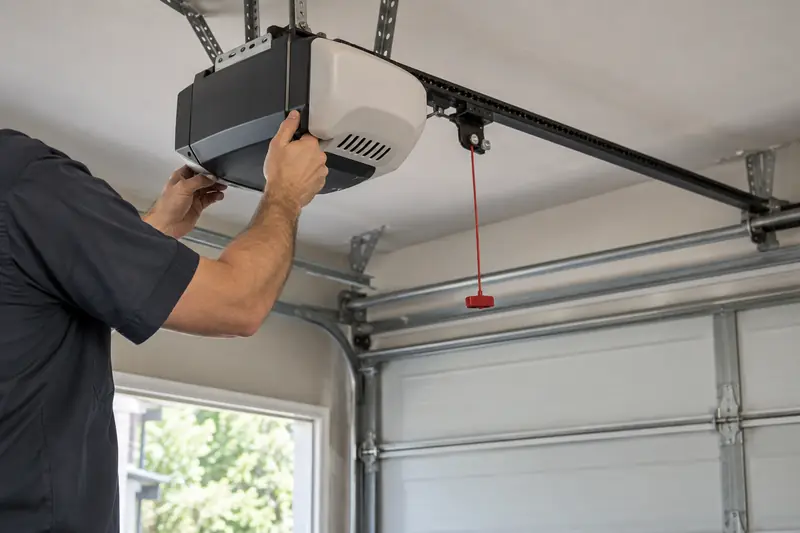
Opener or door: finding the real fault
An opener moves a door that should already be balanced and able to travel freely. If the door is heavy, crooked or binding, a new motor alone will not solve it.
Diagnosis starts by separating the controls, power, drive mechanism, safety devices and the physical door. Does the wall button work when the remote does not? Does the unit light up?
Does the motor run while the trolley stays still? Does the door start down and reverse? Does it happen every time or only in certain conditions?
"The wall button lights up. The opener clicks twice, then the door stays closed. The remote does the same thing." That is more helpful than "the opener is broken."
Common garage door opener problems
- No lights or response Power, outlet, breaker, plug, electronics or a control connection.
- Wall control works, remote does not Remote battery, programming, interference or the receiver.
- Motor hums, door does not move Drive gear, belt, chain, trolley, release or door balance.
- Door closes partway, then reverses A sensor, travel setting, force response or something in the door's path.
- Opener is noisy or slow Worn drive parts, a loose mount, door friction or poor counterbalance.
- Keypad or smart control is unreliable Batteries, programming, range, Wi-Fi or the app account.
Opener not responding
If the unit is dark and silent, start with what you can see without touching wiring: is it plugged in, do the garage lights and other outlets work, did a breaker trip, did a wall switch cut the outlet?
A recurring trip or a damaged cord needs a qualified electrician.
If the unit lights but ignores commands, compare the wall button, remotes, keypad and app.
A wall button that works while all remotes fail points to lock mode, the receiver or programming. After a Rockville summer storm or winter outage, note whether everything stopped at once.
If the door is stuck closed with a car inside, say so early.
If the door is partly open or looks damaged, do not pull the manual release without guidance; a heavy door can move unexpectedly.
Motor runs but the door will not move
A running motor does not prove the opener is connected to the door. The trolley links the drive to the door arm, and a manual release disconnects them.
The belt or chain may move while the door stays still, or the motor may turn without moving the drive. A worn gear or a broken carriage causes similar symptoms.
Counterbalance must be checked at the same time.
If a spring broke, the opener is trying to lift far more weight than it was built for, and replacing the motor without fixing the spring repeats the problem.
In winter, a door frozen to the slab gives the same symptom.
Do not keep pressing the remote to make a stuck door move. The opener can overheat or bend the arm and the top section.
Safety sensors and doors that will not close
Photo-eye sensors sit near the floor on each side of the opening. When the beam is blocked or the sensors are out of line, the opener will not close the door or reverses it.
Bins, bikes, leaves and snow shovels are common causes. Clear what you can see, but never bypass the sensors.
Sensor indicator lights help describe the problem, though their meaning varies by brand.
Tell the technician whether one or both lights are on, steady or blinking, and whether the opener lights flash after a failed close.
Reversal can also come from the door: a roller that catches, a shifted track, a binding section or ice at the threshold.
The fix is to correct the door, not to raise the force until it closes.
Remote, keypad and wall control problems
If the wall button works but one remote does not, try a fresh battery and a second remote.
If every remote stopped together, look at lock mode, the receiver or programming. Outdoor keypads have their own batteries and can fail from moisture and cold.
Smartphone control adds Wi-Fi, a hub, the opener radio, an account and an app, each of which can fail separately. If the wall button and remotes still work, the opener may be fine.
Never share your account password; use the manufacturer's setup to grant access. If a remote is lost or stolen, ask for the opener's memory to be cleared and your controls reprogrammed.
Opener repair or replacement
| Finding | Repair may make sense | Replacement may make sense |
|---|---|---|
| Remote or keypad failure | A battery, programming or a compatible control fixes it | Controls are no longer available for the receiver |
| Safety sensor fault | Alignment, wiring or a compatible sensor | Required parts are unavailable |
| Drive or gear damage | The model has parts and the rest is sound | Repeated failures or no parts |
| Door heavy or binding | Repair the door hardware first | A new opener only after the door runs correctly |
When comparing a repair with a new unit, include installation, compatible controls, removal of the old unit, setup, safety testing and the separate product and labor warranties.
Battery backup, a quieter belt drive or a wall-mount unit can be worth it if they fit your garage. Never use a stronger opener to compensate for a heavy door.
What to tell the technician
Write down
- Whether the wall button, remote, keypad and app each work.
- What the motor, rail and door do after a command.
- Any blinking light or error code.
- When the problem started and whether it comes and goes.
- The opener model, if you can read it from the floor.
Ask the technician
- Was the door and its spring balance checked?
- Which opener part failed, and how was it tested?
- Are replacement controls compatible with my existing ones?
- Which safety functions were tested after the repair?
Types of garage door openers
| Drive type | How it works | Good to know |
|---|---|---|
| Chain drive | A steel chain pulls the trolley along the rail | Long-lasting and common; the noisiest choice |
| Belt drive | A reinforced belt in place of the chain | Quiet; a good fit with a bedroom over or beside the garage |
| Screw drive | A threaded rod moves the trolley | Few moving parts; some slow down in cold weather |
| Wall-mount | Mounted beside the door, turning the spring shaft | Clears the ceiling; needs a compatible torsion setup |
The drive type decides how the opener sounds and which parts wear, not how much weight it can safely lift.
Every opener relies on springs that balance the door. A heavier door needs a correctly rated opener, but extra motor power never substitutes for correct spring balance.
Many Rockville homes have a bedroom over the garage, especially in split-levels.
If noise matters, ask about a belt drive or wall-mount unit, and have the rollers and hinges checked too, since they cause much of the noise.
The monthly safety reverse test
Openers made for sale in the United States since 1993 must have a second protection against trapping someone, usually the photo-eye sensors near the floor.
The opener should also reverse when the closing door meets something solid.
Industry safety guidance suggests checking both every month.
With the door open, lay a piece of two-by-four flat on the floor in the middle of the opening and close the door; it should reverse when it touches the wood.
Then pass an object such as a roll of paper towels through the sensor beam as the door closes; the door should stop and reopen.
Test with an object, never a hand or foot, and keep children well away from the moving door. If either test fails, stop using the opener to close the door and call.
Cold weather and opener trouble
Rockville winters cause their own opener calls. Cold thickens the grease on the drive and in the door's rollers, so the opener works harder and may stop or reverse partway.
A bottom seal frozen to the slab can make the opener strain and pull the top section. Snow and ice piled at the threshold can block the sensors or stop the door short.
- Free a frozen door gently Clear snow and ice along the bottom first. Never use the opener to rip a frozen door off the slab.
- Keep the sensors clear Brush snow off both sensors and the floor between them.
- Do not raise the force If the door reverses in cold weather, find the cause; more force can bend the door or defeat the safety reverse.
- Watch for a heavy door Springs often break on the coldest mornings, and a broken spring can look like an opener that died overnight.
Battery backup and power outages
Some openers include a backup battery that runs the door for a limited number of cycles in a power outage.
That is useful in Rockville when summer storms or winter ice bring lines down and the car is inside.
Backup batteries wear out like any battery; a beeping opener or a battery light often means the battery needs replacing.
Without power, the door can be opened by hand with the manual release, but only when the door is fully closed and the springs are intact.
If a spring is broken, leave the release alone and call; the door can be far heavier than it looks.
Openers and the rest of the door
Many calls that start as an opener problem end at the safety sensors, especially in winter when snow and slush block the beam.
Garage door sensor repair covers that job, and there is more on garage door repair here in Rockville.
Garage door opener repair questions
Why does my opener run but not lift the door?
The trolley may be disconnected, a drive part may have failed, or a broken spring has made the door too heavy. Stop pressing the button and call.
Why does the door open but refuse to close?
Usually the sensors are blocked or out of line, or something drags in the track. Do not bypass the sensors.
Can a broken spring look like an opener failure?
Yes. The opener tries to lift a door that has lost its counterbalance and stops after a few inches.
What if only the remote stopped working?
Try a fresh battery and compare with the wall button and another remote.
Do I need a new opener because the keypad failed?
Not necessarily. The keypad may need a battery, reprogramming or a compatible replacement.
What do blinking sensor lights mean?
They are clues, but the patterns vary by brand. Note which side blinks and tell the technician.
Will a new opener make a noisy door quiet?
Only if the opener is the noise. Rollers, hinges and track usually make most of it.
Are calls answered after hours?
Yes, at all hours. Ask for the next available visit and any timing charge on the call.
Why does my opener struggle on cold mornings?
Cold thickens grease, a frozen bottom seal holds the door down and springs often break in the cold. Do not raise the force; have the door and opener checked.
How often should I test the safety reverse?
Once a month: an object on the floor in the doorway, then something passed through the sensor beam. If either test fails, stop using the opener to close the door.
Which opener is quietest?
Belt-drive and wall-mount openers are usually quieter than chain drives. Worn rollers and hinges add noise of their own.
Why does the opener beep?
Often a backup battery that is failing or discharged. Note the pattern and tell the technician.
Talk it through with a person, any hour.
Call NowEvery day, at all hours (Eastern time). A person answers at any hour, asks what the door is doing, and sets up a visit with one of our technicians, who works Rockville.